

 Dịch
DịchAdmissions Policy
This policy applies to all trainings, classes, or any other programs using Arica Institute’s licensed materials, whether operated by Arica Institute or a licensed third party Sponsor. This policy will refer to any such training or class as an “Arica Group Training” or “Training.”
Oscar Ichazo is the sole Author of all Trainings and owner of trademarks, copyrights and intellectual property of Arica Trainings.
Arica Institute licenses Oscar Ichazo copyrighted and trademarked materials to Sponsors, who have received appropriate training in the Arica method. Only licensed Sponsors and the Arica Institute are permitted to conduct Arica Trainings. Arica Institute requires each Sponsor to conduct its Arica Trainings in accordance with this Admissions Policy, as well as all applicable laws and regulations. Arica Institute is not responsible for any Sponsor’s failure to abide by this policy or any applicable laws or regulations. Each Sponsor is responsible for evaluating and admitting candidates for Arica Trainings conducted by that Sponsor, and exercises discretion over admission decisions for Arica Trainings conducted by that Sponsor, including discretion to decline admission to anyone who, in the opinion of the Sponsor, is unable to meet the admissions requirements. Any concerns regarding the application process or admissions decisions for an Arica Training should be directed to the Sponsor conducting that training.
NOTICE OF NONDISCRIMINATORY POLICY
The Arica Institute and licensed Sponsors admit students of any race, gender, color, national and ethnic origin to all the rights, privileges, programs, and activities generally accorded or made available through the Arica Institute or Arica Trainings.
Arica Institute and licensed Sponsors will make reasonable accommodations for qualified disabilities, provided these do not significantly interfere with the learning process and training environment of Arica Trainings.
REQUIREMENTS FOR ADMISSION
In order to maintain the high quality of Arica Trainings, the Sponsor must exercise discretion over the application process, and reserves the right to deny admission to anyone who, in the sole discretion of the Sponsor, is unable to meet the admissions requirements.
To be admitted to a Training, or other activity using the Arica method, all applicants must be able to meet the following requirements, as determined by the Sponsor:
- Arica Trainings require a degree of physical, emotional, and mental exertion and stamina. Participants must have sufficient health and capacity in each of these areas to participate in all elements of the program without interfering unduly in the learning process and training environment for other participants.
- Participants must be able to participate in meditation, work well in a group, and demonstrate sufficient intellectual and emotional maturity to participate fully in the training.
- Arica Trainings do not confer any professional qualification in Arica material, nor do they confer permission to teach or use the copyrighted material or other intellectual property in any way. In order to protect Arica Institute’s and/or Oscar Ichazo’s copyrighted material and other intellectual property, licensed Sponsors reserve the right to decline admission to a participant who:
- has previously violated Arica’s and/or Oscar Ichazo’s intellectual property rights, including copyrights, trademarks, trade secrets, or other proprietary rights;
- has engaged in unauthorized use of Arica Institute’s and/or Oscar Ichazo’s intellectual property, including copyrighted material related to Arica Trainings;
- is involved professionally in any unauthorized use of such material;
- demonstrates an intention to use such material in an unauthorized manner.
Also,
- Prospective participants will undergo an interview as part of the admissions process.
- Participants must sign a non-disclosure agreement, agreeing that they will not use or disclose the information learned in any way that would violate any intellectual property rights or proprietary rights of Arica or its licensors.
- Participants must sign a release of liability agreement and may be required to sign a participant’s limited license agreement before being admitted to Arica Trainings.
- If anything is missing from a prospective participant’s application file, the Sponsor will offer a limited window in which to provide the outstanding information.
Code of Conduct
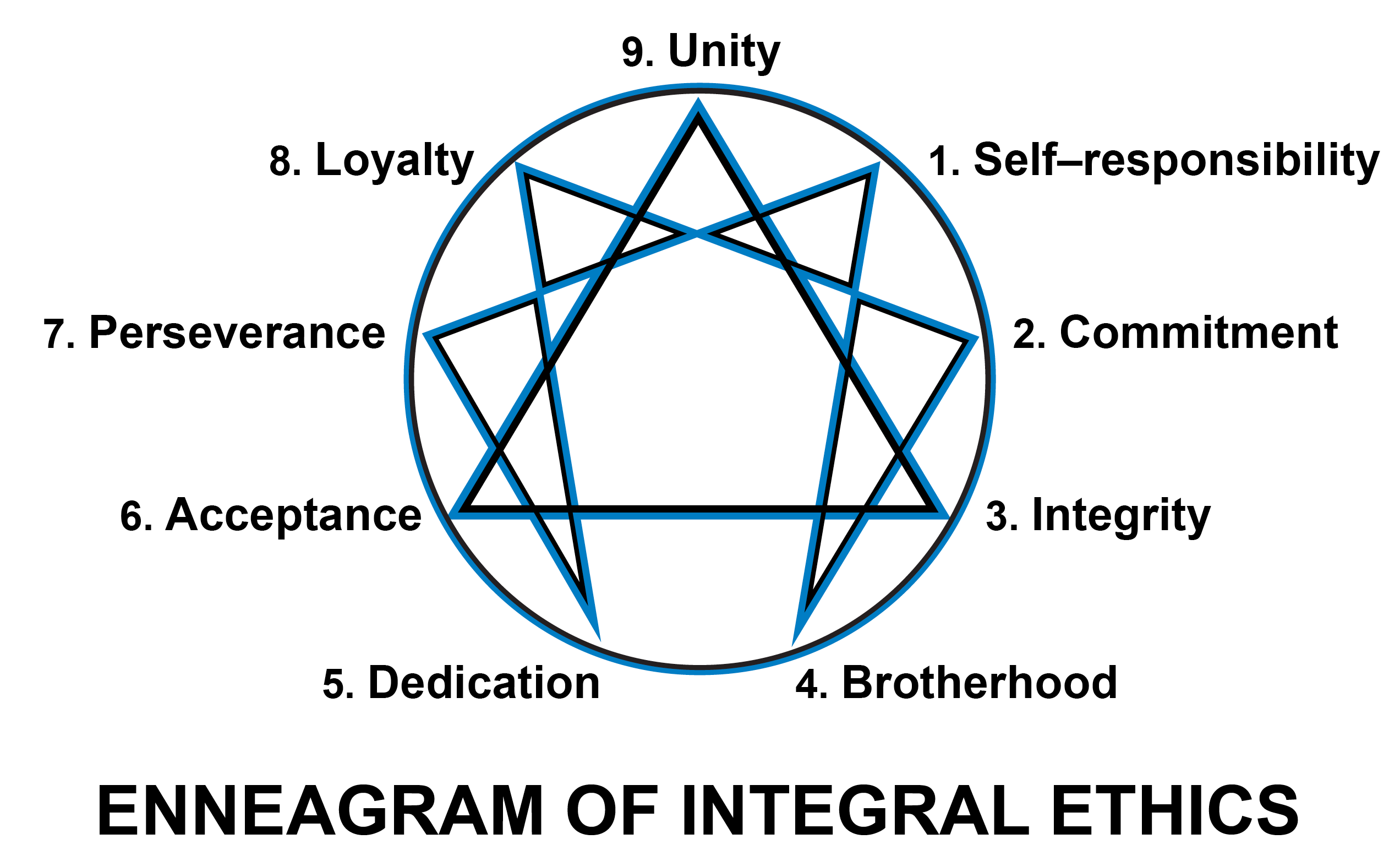 The Arica School, including its organizations, Arica Institute, and The Oscar Ichazo Foundation, is aligned with the nine Integral Ethics and the principle that the Arica Teachings are available to every person who is interested in benefiting from the Arica curriculum. Given this basic condition, all conduct, activities and deliberations of Arica and its organizations’ employees, Sponsors, Organizers, Profactors, training team members, support staff, and volunteers, and the conduct of members of the public participating in Arica programs, will be guided by the nine Integral Ethics and the Arica Code of Conduct. When embodied as an orientation toward The Good for all humanity, the nine points are expressed as higher behavioral manifestations.
ANTI-DISCRIMINATION POLICIES
Arica does not discriminate on the basis of race, color, religion, creed, gender, gender expression, age, national origin, ancestry, disability, marital status, sexual orientation, military or veteran status, or any other legally protected category, in any of its activities, operations, or programs. Arica is committed to providing an inclusive and welcoming environment for all members of its staff, clients, volunteers, subcontractors, vendors and clients, and for its membership and all those who participate in Arica programs. All AI and OIF officers and directors, employees, Sponsors, trainers, apprentices and volunteers, team members, and all participants in Arica programs are expected to abide by these principles.
For Arica Group Trainings, AI and licensed Sponsors are expected to make reasonable accommodations for qualified disabilities, provided accommodations do not significantly interfere with the learning process and training environment.
ANTI-HARASSMENT PRINCIPLES
Arica is committed in all areas to providing a work, membership and program environment that is free from unlawful harassment based upon an individual’s gender, gender expression, sexual orientation, race, national origin, disability, marital status, military or veteran status, age, religion, or any other legally protected category. Such harassment will not be tolerated. All AI and OIF officers and directors, employees, Sponsors, trainers, apprentices and volunteers, team members, and all participants in Arica programs are expected to abide by these principles.
Sexual harassment may include behavior of a sexual nature that is unwelcome and offensive to the person or persons targeted. Examples of sexually harassing behavior may include unwanted physical contact, foul language of an offensive sexual nature, sexual propositions, sexual jokes or remarks, obscene gestures or noises, sexual innuendo, graphic comments on a person’s body, displays of pornographic or sexually explicit pictures, drawings, or caricatures, and sexual references including use of emojis with sexual connotations.
FAILURE TO ABIDE BY THE ANTI-HARASSMENT AND ANTI-DISCRIMINATION PRINCIPLES
Failure to abide by the principles outlined above may be grounds for disciplinary action, including termination of the relationship with Arica, AI, and/or OIF.
All Arica Sponsors are required to investigate promptly any complaints of discriminatory or harassing conduct or suspected conduct on the part of training team members, support staff, volunteers and/or participants in Arica Programs. If any person maintains that a Sponsor is not properly investigating their complaint, the person may ask AI to investigate and should contact confidential@arica.org.
| Arica Institute Board of Directors |
The Oscar Ichazo Foundation Board of Directors |
v 2022-10-18
Permission to Publish
Oscar Ichazo is the author of some two hundred works which are registered with the United States Copyright Office. The distribution or re-publication of Arica materials is generally not permitted. However, permissions for re-publication of limited excerpts of materials which adhere to standard Fair Use principles, and the Permissions Policy, will not be unduly withheld and will usually be processed quickly.
More…
Privacy Policy
The personal information you submit in Contact, Payment, or Application forms is stored in a secure database on these websites. Submitted forms are emailed to you and Arica Institute. Payment information is posted to a secure installation of QuickBooks Online. Contact information may be stored in secure databases and in documents stored in a Google Workspace, or in secure databases on our hosting services.
More…
Sustainability
The Arica School is committed to responsible environmental stewardship.
We are transitioning to using Forest Stewardship Council (FSC) or Sustainable Forestry Initiative (SFI) certified paper.
We use a post-consumer high recycled paper content or 100% recycled paper and materials whenever possible.
We use soy- or vegetable-based ink with no or low volatile organic compounds (VOC’s).
We use recycled cardstock for yantras.
Printed yantras are laminated with a very thin lamination material.
Training binders are made from organic recyclable chipboard.
We recycle or reuse as much as possible in our offices.
We will continue to improve as better products and ideas become available.
Wellness Guidelines
The Board of Arica Institute has produced Wellness and Infectious Disease Guidelines for face-to-face programs hosted by either Arica Institute Sponsors or The Oscar Ichazo Foundation Organizers in group trainings and practices.
The guidelines are intended to significantly reduce the risk of serious infections in all face-to-face situations in which the Arica Work occurs. The longer residential trainings offered by Arica Institute, in which there is frequent and sustained contact between participants over a period of up to two weeks, are subject to the strictest regulation. These guidelines reduce but do not eliminate the risk of infection from viruses that cause infectious diseases.
More…